
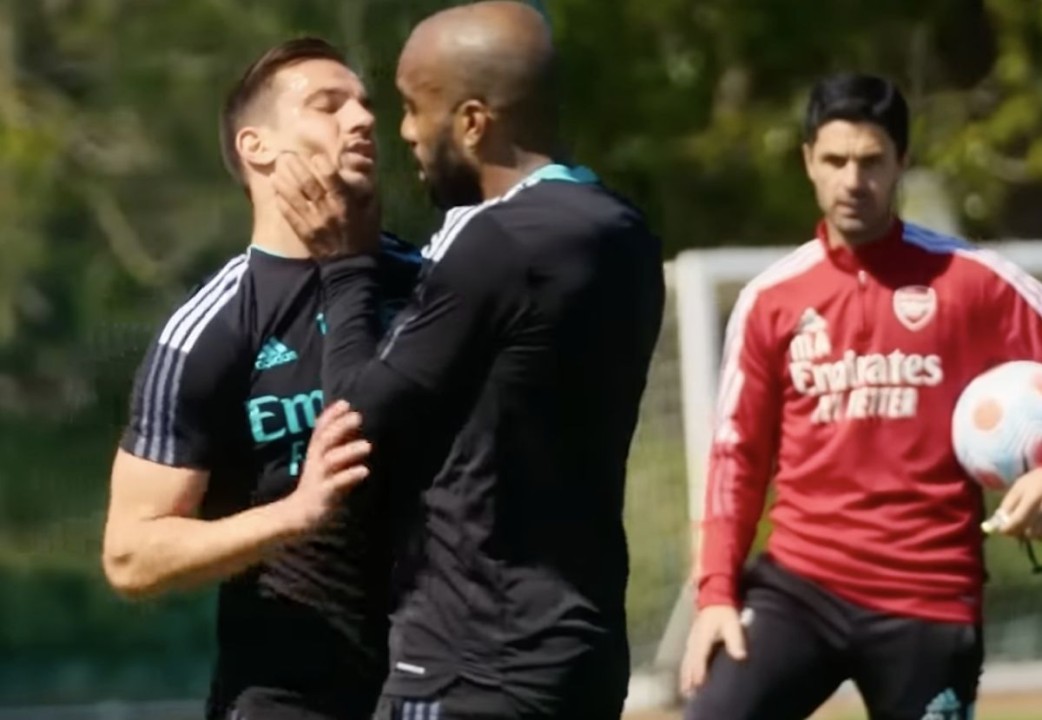

The documentary All or Nothing: Arsenal, showed a situation between the at-the-time Arsenal FC’s captain Alexandre Lacazette and right-back Cédric Soares. The first gets fairly tackled and loses the ball to a young Jack Henry-Francis and then revengefully goes and clamps down the young player.
Then Cédric Soares seems to make a comment (mind you, they’re both on the same team in the training drill) and that makes Lacazette snap and react, grabbing him and it gets physical.
We are unsure of what Cédric has said and which tone he used, but let’s settle that both parties are at fault. What matters to us is, if it was with our team…how would you handle it?
If you were the coach, how would you solve it?
This is a recurring situation. It obviously depends on the individual situations, the people in question and context, but let’s look at different solutions.
Usually when you encounter situations like this, it’s an overflow of energy and there is a momentarily “loss of control”. So you need to be able to take control of the situation. Meaning; either you let it unfold, as you are calm and completely aware of the players reaction – the ones involved + players around – or you intervene to stop it.
With Humour
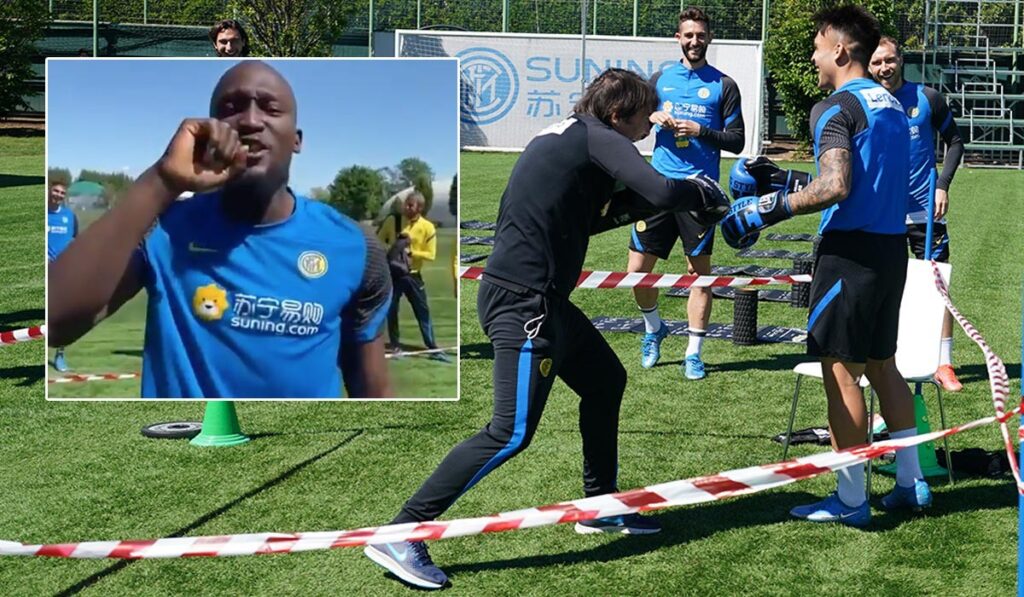
One way is to put some ice on the fire. As the emotions boil up and the situation escalades, as a coach you can put things in perspective by using some humour. Recently we’ve seen a situation between Antonio Conte at Inter Milan with one of his players, as the player was subbed off during a Serie A match, there was a reaction that clearly showed the player was unhappy and did not agree with the coaches decision. As this was such a public moment and the cameras were straight on the player there was no denying that it happened, in this case they actually resolved with some humour. So on one of the next training sessions they set up a mini boxing ring and both coach and the player put on some boxing gloves and simulated a boxing match. With many smiles and laughter from all involved, plus a good and fun environment, the situation was dealt with.
With Discipline
If the situation is worryingly increasing in magnitude and if you feel this action could have long term repercussions on the group dynamics, then you have to make sure that you stop the situation there and then. In certain groups you might feel the need to stop the situation and clearly show to the ones involved and the people around that this is unacceptable way of dealing with disagreements. It can be with a younger age group, it can be with groups that are unstable due to social circumstances, or it can be in an environment where a competitive edge is not expected.
So many ways of dealing with this scenario can be applied. There can be a fine, which would be a monetary way of punishing the people involved. It could be with a ban for a determined time of attending the club facilities. Expect an internal and/or public apology from the people involved, or a creation/review of an internal rule book or code of conduct.
With Neutrality
You can also deal with it with some neutrality and accept that this is something that happens daily in high performance environments, where the individuals involved are intense, with strong egos and passionate.
Very often, if the changing room is strong and there are strong figures of authority and a clear hierarchy then these situations are very easily dealt with within the group. It certainly wouldn’t be the first time someone has dealt with the situation like that and so they would know how to deal with it, and actually add more to the team spirit than otherwise.
How do you communicate it?
Internally
In such cases, you need to address the situation to the club board or directors, to the staff and the people involved with the club. However, the way you present and in which light you shed to the situation, can have different impacts on how other people perceive the event.
If the receivers of the message want to make the situation bigger than it was, for example to say that there is a problem with indiscipline within the team, questioning the leadership of the coach or coaching staff. On the other hand, if we flash a positive light on situations like this, for example saying that it adds competitiveness, intensity, winning mentality, fighting mentality, then we can actually turn this situation into an event that added more closeness to the team and actually improved the team spirit.
Externally
With the modern day exposure of football, with the constant attention from the press and social media, many of these situations can be filmed and even caught live on camera. So not only the fans of our club, but rivals and other teams, will have a view and an opinion about these cases. So the coaching staff needs to be very quick and firm to deal with the situation like this. There needs to be a view from the external parts that there is control within the club from the coaching staff, and that situations like this even if they are unpredictable, they have a clear way of dealing with such cases.
Going Forward
Ideally, you’ve built a culture where a conflict or a situation where emotions are exposed in such a way, actually helps to strength the team spirit. If such a situation like this adds more stress and tension within the team, then your actions have to be more decisive.
In different high performance environments, there is the habit of signalling such emotional events with a distinction. As to note that going through such emotional events adds so much to a persons / groups experience, that it must become a memorable episode.
It would also be advantageous to create a form of aggregating all these events in a way that when the players reviewed it, would bring more energy and more cohesion to our team.
Conclusion
Internal disagreements can be a daily situation. As a coach and as a leader of a team of players – who you’d want to train at their highest ability – you would expect that emotions sometimes will overflow. Therefore you need to be ready to react when situations like this occur and deal with it in the most effective way.
With humour, discipline or a more observational stance, it is important that players and supporting staff feel that you are in control of the situation.
Situations like the ones exposed above, should be a great opportunity to build further on team spirit, group cohesion and a healthy competitive environment.
Frederico Morais.