

It’s great to have players of yours involved with the national team, as that means you have players with above average quality. However, with it comes some logistic challenges, for both coaching staff and the player himself. We will look at how we reintegrate a player back from the trip. Having an idea of the competitive and training load and schedule the player had at the national team will help have an idea of what steps to take. Know what is his injury status or physical availability. How he can be reintegrated to team practice (regarding what kind of training session day it is). We will also review strategies on how to put the player(s) up to speed with the club’s next match plan.
We should gather as much information as possible. Extremely important to have a great dialog with the National Team staff, not only between coaches, but the medical teams of both parties, together with the player, so that the transition can go as clear and smoothly as possible.
If he is a South American player, then the trip would include a minimum of an 8 hour two way flight. Travelling through time zones and affecting his sleep. The commute to the airport and then from the airport to the place where the national team is staying, adds more stress and energy being used. It’s important that the logistics department of the club can organise the trip, so it flows smoothly for the player. The nutritional department should also create a meal plan and pack for the player.
The travel back is fundamental to optimise time and energy. So after looking at the schedule, the club has to organise the trip in the best way possible. Some players prefer to travel the day after the national team match is played, other prefer to travel on the night after the match is played. The positives of traveling the following day, is that you can potentially have a better night sleep and a proper breakfast the next morning, and less stress post match with the travelling. The negatives are that he would then have one day less back at the club, plus a post match sleep schedule is always affected anyway so he would potentially also have an irregular night sleep. If he was to travel after the match, then the positives would be that he would be back at the club’s country the same day, he would eventually sleep at home the same night, and then gain one day in the preparation for the next match, even potentially having a day off given by the club. The negatives would be that the trip would be post match, where the sleep and time schedule could be affected, and then actually taking one extra day to get back in the rhythm. This is if we don’t have any unforeseen events along the way, like delayed flights or traffic.
After making sure the plans for the player to get back are in place, we start with the basics. Is he injured? If so, does he need a medical screening and assessment and do we need to set the rehab schedules. If not, how is his physical condition? Does he need a recovery plan? Is he able to join training but in a conditioned manner?
It would then be important to collect the information regarding his match minutes, training regime, training load and other events (such as public events).
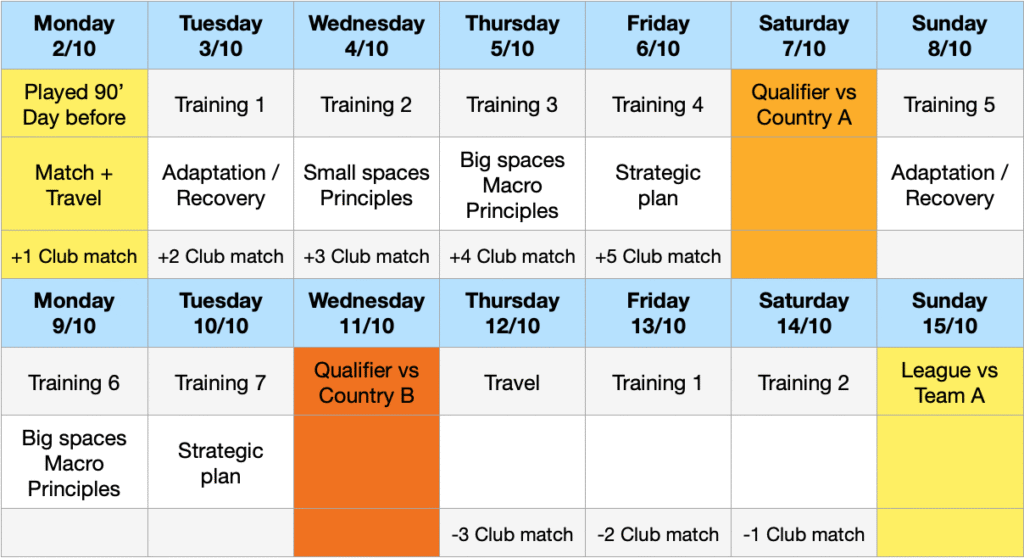
After gathering all the above mentioned information, it’s time to plan the readmission of the player back at the club.
Depending on the number of players we have coming back or the travel arrangements, we can possibly change the session to an afternoon time or later in the morning. That would allow the player(s) to join the session and mentally and physically start focusing on the next match. Other players would just prefer to keep the same schedule, even though they probably didn’t rest fully, they would then have 24hrs to recover to the session on the following day, rather than changing it to the afternoon and having a fraction of that time.
We should plan the type of training they do. Are they ready to join team training? If so, then team training should be adapted so that the player can join fully. Another possibility is to have an individual / group training, where it would be easier to control the elements the player would be exposed to. As some players would be on their +1, while others would be on their +2, it is fundamental to distinguish the availability of each player and how each player reacts to the traveling. As we know that changes of environment, altered routines, highly increase the risk of injury.
Then the type of alternative training can be planned for the player(s) in question. Would it be an individual position specific session? Could it be an Active Recovery session where the focus is to get the player prepared for the following day. Although it wouldn’t be a very specific session, it would then liberate the player for a better readiness the following day, where he will be expected to join the main session.
There is also the possibility of having an indoor session. A gym session with a focus on recovery and activating the body for the next day could be also beneficial. The wear that it could cause would be minimal, so the player could even feel fresher for the following day. Plus having a very low risk of injury.
We could also employ effective and proven recovery techniques. Active recovery is still king when recovery is concerned, as the increased blood flow, and the venous pump help aid the recovery mechanisms of the body. Cryotherapy can be effective when the competitive moments are so close, however it does affect the natural inflammatory processes of the body. Contrast water therapy, compression tights/socks, are some other strategies that can be used to aid recovery, together with a sublime sleep and nutrition.
Once the player arrives, we need to set up strategies to put him up to speed with the match preparation. We would respect the players commitment and focus on the national team and not provide extra information during that timeframe. However, once the player arrives we need to be full focus towards the next match.
The first thing would be an individual meeting with the player, to get updated with the trip to the national team, how the matches went, how he feels and generally grasp the players status. At the same meeting we can present the tactical and strategic plan for the next match. This could be a situation where he would only play 45 minutes, or start the match on the bench, scenarios in line with the player availability. It would also be an enriching strategy to present a video of the direct opponent and the direct opponents line. That would then help the player be identified with the opponent and what is expected for him to be exposed to. To update the player on what plan we have for him for the set pieces we have in hand and the role he would play in them.
Having our players representing their national teams is a reason for rejoice from the club. It means that they have the quality to be part of such an elite group. It is our job, as the responsible party for the players well being, that we organise and cooperate with the national team to have a smooth and straight forward trip and commute for the player.
The least energy and tiredness the player is exposed to, the quicker the recovery process will be, however there is a wear and tear of such a trip and we need to have strategies to work with that. Making sure the medical and nutrition department set up the accessories the player needs to travel, plus how his nutrition will be during the trip. The physical coaches then need to be in sync with the national team staff and the player, so they are aware of the physical demands of the training and matches for the player.
Once the player arrives at the club, then we need to make sure the session is adapted to match his needs, or have alternative solutions for him to come back into the best shape possible as soon as possible. Inform the player of the match plan, the challenges he might face and our strategic plans for the next match will help to refocus the player to the team’s goals and objectives for the season.